On this page
Introduction
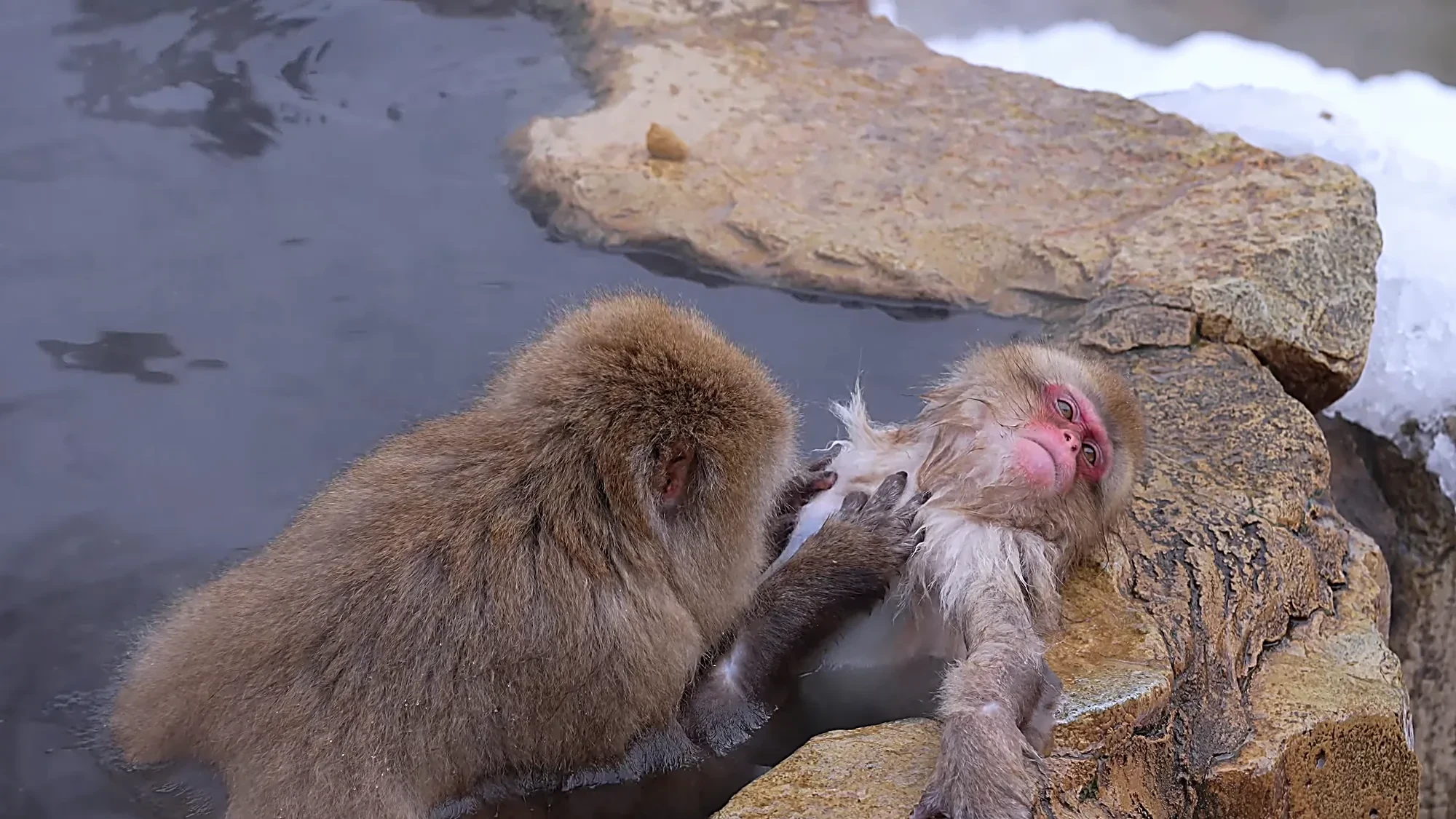
Nowhere else in the world do wild monkeys bathe in hot springs. At Jigokudani Monkey Park (地獄谷野猿公苑, Jigokudani Yaen Kōen), deep in the mountains of Nagano Prefecture, Japan, a troop of Japanese macaques — the famous snow monkeys — soak in steaming outdoor pools while snow blankets the surrounding forest. Their reddened faces, framed by thick grey-brown fur and clouds of rising steam, have become one of the most recognizable wildlife images on earth.
The behavior began in the early 1960s, when a young female macaque was spotted wading into an outdoor bath at a nearby ryokan (traditional inn). Others in the troop soon imitated her. Over the following years, park staff built a dedicated hot spring pool within the monkeys’ natural territory to draw them away from human bathing areas, and successive generations have carried on the habit ever since. Today, Jigokudani remains one of the most reliable and accessible wildlife viewing destinations in Japan.
The name Jigokudani translates to “Hell Valley” — a reference to the volcanic steam vents and boiling water that seep from the rocky terrain. Perched at roughly 850 meters in the Yokoyu River valley, the park is flanked by steep cliffs and dense forest. It feels genuinely remote. Yet it sits less than an hour from Nagano city and is reachable as a day trip from Tokyo.

The monkeys roam free among visitors — this young one settled on the path a step away as people watched. Keep your distance and don't touch.
At a Glance: Planning Your Visit
Best months for snow monkeys in the hot spring: January and February. December and March are also good, though snow and cold are less consistent at the edges of winter.
Travel time from Tokyo: Approximately 2.5 to 3 hours each way by shinkansen and local transport.
Trail walk to the park: 1.6 kilometers (about 25–35 minutes) each way along a forested river path. No vehicle access to the park itself.
Ticket price: 800 yen (~$5) for adults, 400 yen (~$3) for children ages 6–17. Children under 6 enter free.
Nearest onsen towns: Shibu Onsen (closest to the trailhead) and Yudanaka Onsen (main railway terminus).
Day trip or overnight? A day trip from Tokyo is feasible if you depart by 8:00 AM. An overnight stay in Shibu Onsen or Yudanaka Onsen is strongly recommended — it allows an early morning visit to the park and adds the experience of traditional ryokan accommodation and hot spring bathing.
Will you see monkeys? The troop is present year-round and sightings are highly consistent, especially in winter. Monkeys are most likely to be in the hot spring during cold weather. There is no guarantee on any given day, but the odds are strongly in your favor from December through March.
Quick Facts: Jigokudani Monkey Park
Official name: Jigokudani Yaen Kōen (地獄谷野猿公苑)
Location: Yamanouchi, Shimotakai District, Nagano Prefecture, Japan
Elevation: Approximately 850 meters
Best season: December through March for snow; monkeys are present year-round
Nearest towns: Shibu Onsen, Yudanaka Onsen
Nearest major city: Nagano (approximately 40 minutes by train and bus)
Distance from Tokyo: Approximately 250 kilometers (around 2.5–3 hours by shinkansen and local transport)
Troop size: Approximately 160 Japanese macaques
Year established: 1964
What Is Jigokudani Monkey Park?
Jigokudani Monkey Park is a wildlife observation area inside Joshinetsu Kogen National Park. Visitors come here to watch a free-ranging troop of Japanese macaques (Macaca fuscata) in their natural mountain habitat. This is not a zoo. The monkeys are entirely wild — free to come and go as they choose, never caged or handled. What sets the site apart globally is the troop’s habitual use of a human-built hot spring pool, a behavior that developed on its own and has now persisted for more than sixty years.
The full scene from above — the single pool, the snow-bound gorge, and the whole troop gathered to soak.
Japanese macaques are the northernmost-living nonhuman primates in the world, native to Honshu, Shikoku, Kyushu, and the small southern island of Yakushima. They are built for cold. At Jigokudani, winter temperatures regularly drop below minus 10 degrees Celsius, and the macaques endure them with thick, insulating fur ranging from brown to grey. Their red faces and hindquarters — a signature feature of the species — result from bare skin flushing with blood flow.
Hot spring bathing is not instinctive to Japanese macaques. It is a culturally transmitted behavior unique to this troop. The first monkey observed entering a hot spring did so in 1963, apparently copying humans at a nearby inn. Others learned by watching, and mothers passed the habit to their young. Primatologists regard this as one of the clearest examples of cultural learning in a nonhuman species.
Park staff maintain the hot spring pool and scatter supplemental food — mainly raw barley and soybeans — to encourage the troop to gather in the viewing area. The feeding is calibrated to avoid dependence while giving visitors a strong chance of seeing the monkeys up close. Still, these are wild animals on their own schedule, and their presence on any given day is never guaranteed. In winter, sightings are highly consistent.
Where Is Jigokudani Monkey Park Located?
The park sits in the town of Yamanouchi, Shimotakai District, on the main island of Honshu. Nagano Prefecture occupies the mountainous interior of central Japan — an area sometimes called the “Japanese Alps” for its dramatic peaks and deep valleys. Jigokudani falls within the boundaries of Joshinetsu Kogen National Park, a protected landscape of volcanic highlands, dense forest, and well-known hot spring resorts.
Two small hot spring villages serve as the gateway to the snow monkey park in Nagano. Yudanaka Onsen, the terminus of the Nagano Dentetsu railway line, is the main transit hub for visitors arriving by public transport. Shibu Onsen, slightly closer to the trailhead, is smaller and more atmospheric — its narrow, stone-paved lanes lined with wooden ryokan give it a timeless quality.
Google Maps — Jigokudani Monkey Park
Tokyo lies roughly 250 kilometers to the southeast. Getting here means taking the Hokuriku Shinkansen to Nagano Station, transferring to the Nagano Dentetsu line to Yudanaka Station, then catching a bus or taxi to the trailhead before a final walk through the forest. The total travel time is about three hours each way — long enough to feel like an adventure, short enough to manage as a day trip. That said, an overnight stay is well worth considering.
Nagano city hosted the 1998 Winter Olympics and remains a popular base for skiing, hiking, and cultural tourism. Its most celebrated landmark, Zenkō-ji temple, is one of the most important Buddhist temples in Japan and worth a visit if your schedule allows.
Best Time to See the Snow Monkeys
The park is open year-round, and monkeys inhabit the area in every season. But the experience shifts dramatically depending on when you go. For a detailed seasonal breakdown, see our full Best Time to See the Snow Monkeys guide.
Winter (December–March): Peak Season
Winter draws the largest crowds and delivers the most dramatic scenery — this is when those famous images of snow-dusted monkeys lounging in steaming pools become reality. A few things to keep in mind:
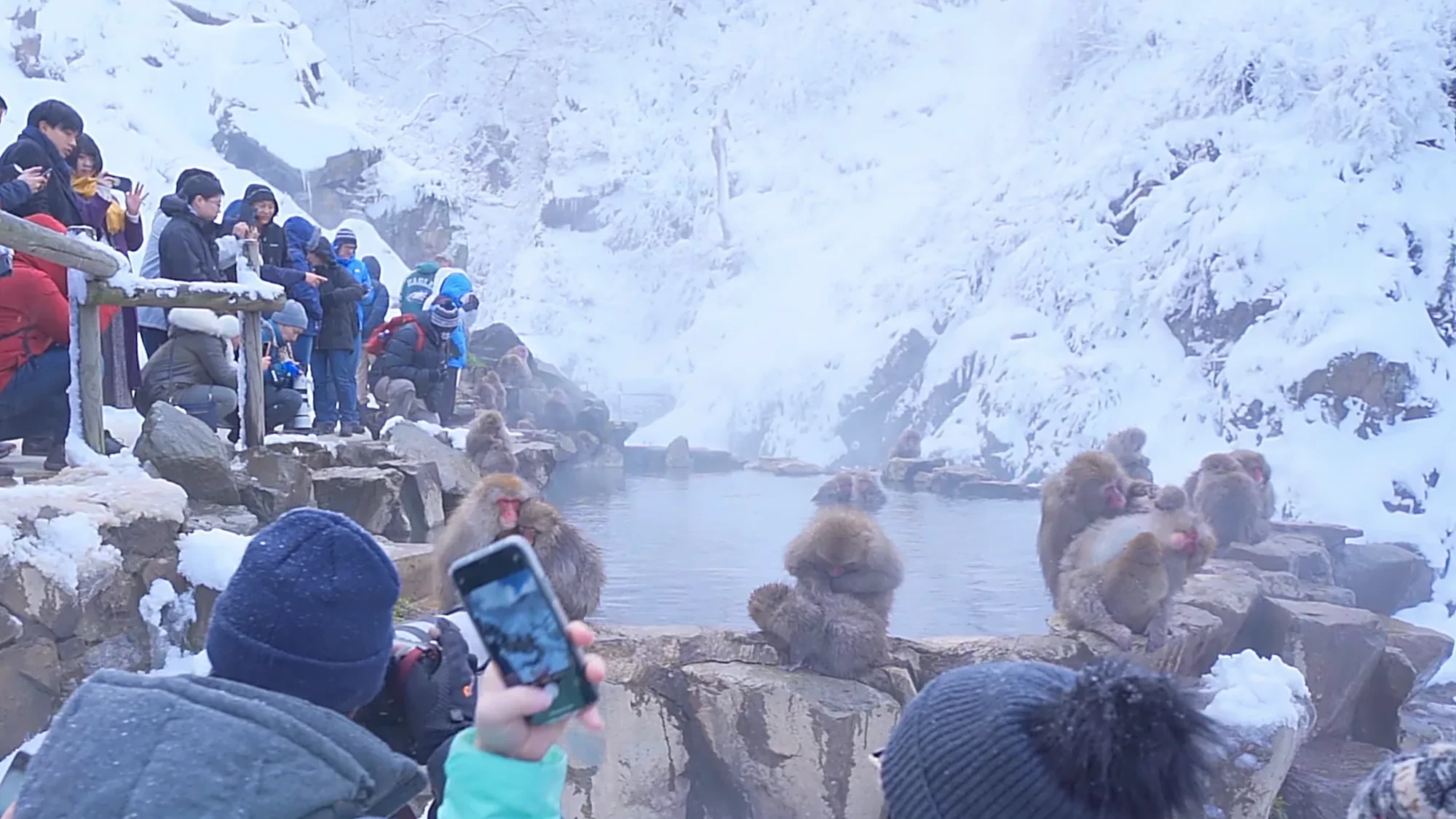
Snow drifting down, faces flushed red, the troop half-submerged in the steaming pool — the scene people travel across the world for.
Snow coverage is most reliable from late December through February, with January and February bringing the heaviest snowfall and coldest temperatures.
Monkeys enter the hot spring most often in genuinely cold weather. The warm water provides real thermal comfort. On milder winter days, fewer of them bother.
Temperatures hover between minus 5 and minus 15 degrees Celsius in midwinter, and wind chill pushes it lower.
Crowds peak during the Japanese New Year holiday period (late December to early January) and on weekends throughout winter. Weekday mornings are the quietest.
Daylight fades early in the mountain valley, and the park closes by late afternoon.
Spring (April–May)
Warmer weather melts the lower-elevation snow, the forest trail becomes easier, and visitor numbers thin out noticeably. Monkeys remain active and visible, though they gravitate toward the hot spring less frequently as air temperatures climb. For those willing to trade the classic snow scene for a calmer atmosphere, spring can be a rewarding window.
Summer (June–August)
The least popular season for visitors, but the park stays open and the troop is present. Lush, green forest canopy replaces the stark winter landscape, and the trail is at its easiest. Hot spring bathing is unlikely in warm weather, yet summer is ideal for observing grooming, foraging, play, and other social behaviors. Late spring through early summer (May–June) is also birth season — infant macaques clinging to their mothers are a strong draw in their own right.
Autumn (September–November)
Pleasant hiking weather coincides with the start of fall foliage in the surrounding mountains. As temperatures drop through October and November, sporadic hot spring bathing picks up again. Fewer visitors and mild conditions make autumn a quiet, underrated time to visit.
Baby monkey season: Infant macaques are typically born between April and June. If seeing very young monkeys appeals to you, a spring or early summer trip is worth planning around — even without snow on the ground.
Do the Monkeys Always Bathe in the Hot Spring?
This is one of the most common questions visitors ask, and the honest answer is: not always, but usually — especially in winter.
The monkeys bathe because the warm water feels good in cold weather. It is a comfort behavior, not a survival requirement. When air temperatures are low and snow is on the ground, the troop gravitates toward the pool throughout the day, and it is common to see a dozen or more macaques soaking at any given time. January and February, when conditions are coldest, offer the most reliable hot spring bathing. December and March are strong months as well, though occasional warm spells can reduce activity at the pool.
Three macaques soak with eyes half-closed as snow drifts down.
On mild winter days — when temperatures hover near zero rather than well below it — fewer monkeys enter the water. They may sit on the surrounding rocks, groom, forage, or simply rest nearby. You will still see plenty of monkeys; they just may not be in the pool.
Outside of winter, hot spring bathing becomes increasingly rare. In spring and autumn, you might catch a few monkeys wading in on a cool morning, but it is not dependable. In summer, the pool sits largely empty. The troop is still present in the area year-round, and the park remains open in every season, but visitors coming specifically for the iconic bathing scene should plan for winter.
No visit carries an absolute guarantee. The monkeys are wild, and their behavior changes day to day. That said, the combination of supplemental feeding by park staff and the troop’s decades-long bathing habit makes Jigokudani one of the most consistent wildlife encounters in Japan. Visitors during peak winter months who arrive early and stay patient rarely leave disappointed.
How Long Do You Need?
How much time to set aside depends on where you are starting and whether you plan to stay overnight.
Park visit only (from the trailhead): Allow two to three hours. The walk in takes 25–35 minutes, most visitors spend 30 minutes to an hour at the viewing area, and the walk out is the same distance in reverse. Photographers and wildlife enthusiasts who want to wait for specific behaviors or lighting conditions should budget more generously — three to four hours from trailhead to trailhead is not unusual.
Half-day trip from Nagano: The train from Nagano to Yudanaka takes 45–70 minutes, followed by a short bus ride and the forest walk. With transit, the visit, and the return journey, expect to spend five to six hours door to door. This works well if Nagano is your base.
Full-day trip from Tokyo: The journey from Tokyo Station to the park takes roughly three hours each way. Departing by 8:00 AM and returning in the late afternoon is manageable but tight, leaving little room for delays or extended time at the park. It is a long day, but it works.
Overnight stay (recommended): Spending a night in Shibu Onsen or Yudanaka Onsen is the most rewarding approach. You can visit the park early the next morning when crowds are thinnest, then return to the village for a hot spring bath and breakfast. The overnight option also opens up time for the ryokan experience — kaiseki dinner, communal baths, and the quiet evening atmosphere of the onsen towns. For most visitors, this turns a good trip into a great one.
How to Get to Jigokudani Monkey Park
For complete route details, transport options, and current fare information, see our full guide: How to Get to Jigokudani Monkey Park.
From Tokyo
The journey breaks into three stages: bullet train to Nagano, local train to Yudanaka, and bus or taxi to the trailhead.
Stage 1: Tokyo to Nagano. Board the Hokuriku Shinkansen at Tokyo Station. The ride to Nagano Station takes 80–100 minutes depending on the service — Kagayaki is the fastest, while Hakutaka makes additional stops. The Japan Rail Pass covers this route fully. Nagano Station has shops, restaurants, and luggage lockers for day-trippers.
Stage 2: Nagano to Yudanaka. Switch to the Nagano Dentetsu railway at Nagano Station. The limited express reaches Yudanaka in about 45 minutes; the local service takes around 70 minutes. This is a private line, so the Japan Rail Pass does not apply — buy a separate ticket for roughly 1,200 yen (~$8) one way.
Google Maps — Yudanaka Station
Stage 3: Yudanaka to the trailhead. A Nagaden bus runs from Yudanaka Station to the Kanbayashi Onsen stop, the closest point to the park trailhead — about 10–15 minutes. A taxi covers the same ground in around 10 minutes. From the bus stop or parking area, a 1.6-kilometer forest trail leads to the park entrance.
Day trip timing: Leave Tokyo Station by 8:00 AM at the latest to allow a comfortable visit and return journey, which follows the same route in reverse.
From Nagano
Follow Stages 2 and 3 above. During peak winter season, a direct express bus runs from Nagano Station to the Snow Monkey Park area, eliminating the train-to-bus transfer. Schedules change seasonally — check with the tourist information desk at Nagano Station.
From Kyoto or Osaka
Two routes work. You can take the Tokaido Shinkansen to Tokyo and transfer to the Hokuriku Shinkansen, or skip the Tokyo backtrack by traveling to Kanazawa via the Thunderbird limited express and picking up the Hokuriku Shinkansen there. Kanazawa to Nagano takes about 65 minutes.
The Walk to the Monkey Park
No road reaches the park itself. From the trailhead near Kanbayashi Onsen, you walk roughly 1.6 kilometers — about a mile — along a forested path that follows the Yokoyu River upstream. At a moderate pace, expect the walk to take 25–35 minutes, depending on the season and conditions underfoot.
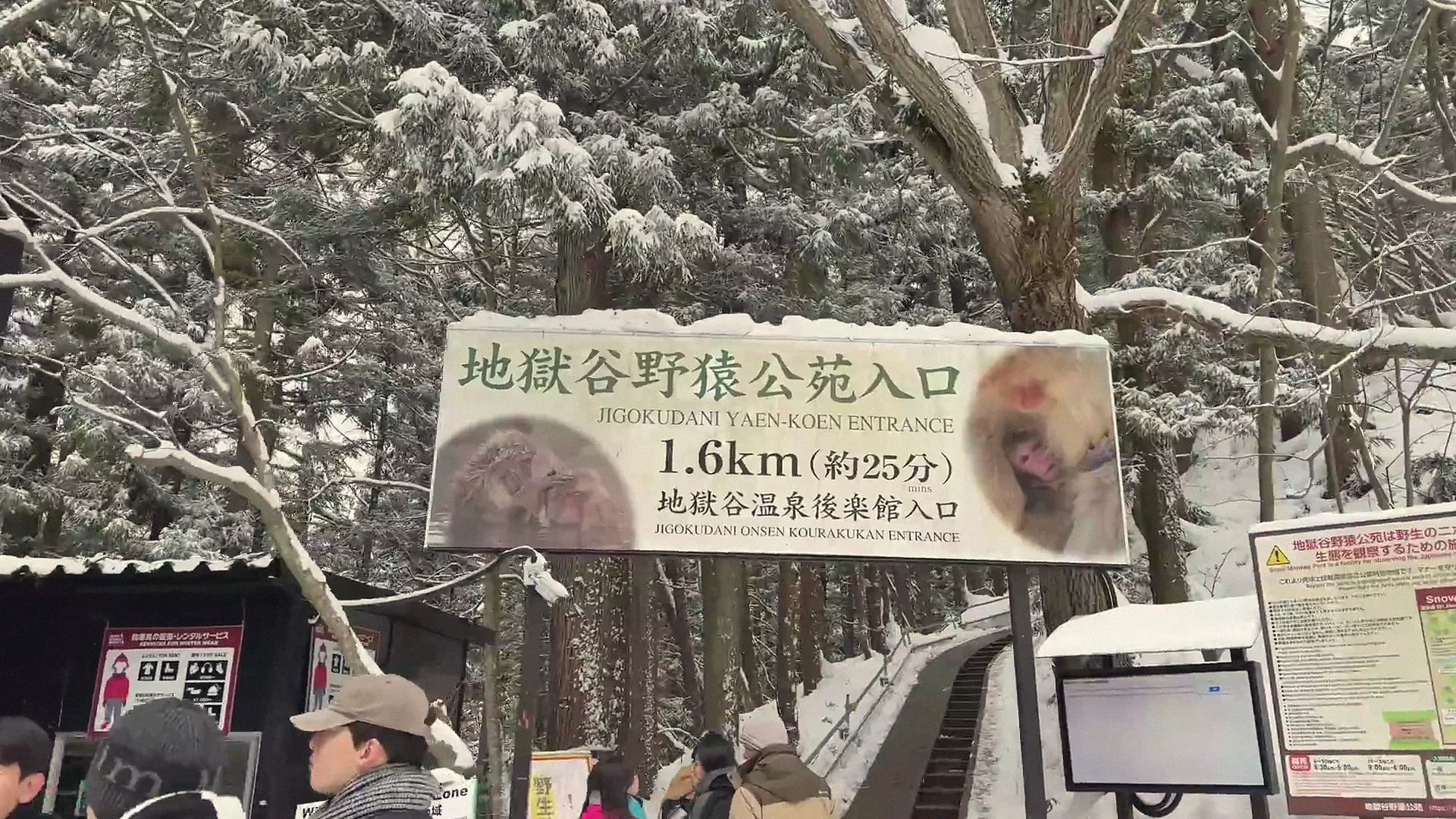
The trail begins here: the banner reads 'Jigokudani Yaen-kōen Entrance — 1.6 km (about 25 minutes),' with Kōrakukan onsen noted just beyond.
Outside of winter, the trail is a pleasant woodland walk. Tall cedars and deciduous trees line the path, the river provides a constant soundtrack, and the surface alternates between compacted earth, gravel, and short stretches of wooden boardwalk. The gradient is mostly flat, with a gentle rise toward the end.
Winter changes things. Packed snow and ice coat the trail, and sections turn slippery. Park staff clear and maintain the path, but proper footwear is non-negotiable — sturdy, waterproof hiking boots or snow boots with aggressive tread. Many visitors attach clip-on crampons or ice grips, available cheaply at outdoor shops in Nagano or even convenience stores near the park. Standard sneakers are a recipe for a difficult, potentially dangerous walk.
There is only one route in and one route out, so budget your time accordingly. The trail is well-marked with no confusing junctions; you cannot really get lost. Restrooms are available at the trailhead and at the park entrance but not along the trail itself.
What to Wear
Getting the right clothing and footwear is one of the most important things you can do to ensure a comfortable visit, particularly in winter. The park sits at 850 meters in a mountain valley, and conditions between December and March are genuinely cold. For a complete packing checklist, see our Travel Tips page.
Footwear is the single most critical item. Waterproof hiking boots or snow boots with deep, aggressive tread are essential for the winter trail. Packed snow and ice cover the path, and flat-soled shoes or standard sneakers offer almost no grip.
Clip-on traction devices — crampons or ice grips that attach to the sole of your boot — are inexpensive and widely available at outdoor retailers in Nagano, at shops near the trailhead, and even at some convenience stores in the Yamanouchi area. They make a significant difference on icy stretches.
Clothing should follow the layering principle. A moisture-wicking thermal base layer, an insulating mid-layer such as fleece or down, and a waterproof, windproof outer shell will handle most winter conditions at the park.
Temperatures regularly sit between minus 5 and minus 15 degrees Celsius, and wind chill can make it feel colder. A warm hat, insulated gloves, and a scarf or neck gaiter are not optional — exposed skin gets cold fast at these temperatures.
Hand and toe warmers are a small addition worth making. Disposable heat packs are sold at virtually every convenience store in Japan (look for the kairo section) and cost very little. Slip them inside your gloves and boots for hours of steady warmth.
Protect your gear. Steam from the hot spring and falling snow will dampen anything you carry. A waterproof backpack cover or a large plastic bag over your pack keeps camera equipment, phones, and personal items dry.
In spring, summer, and autumn, conditions are far milder. Comfortable walking shoes with decent grip are sufficient, and layering can be lighter. Rain gear is advisable in any season — mountain weather shifts quickly.
What to Expect When Visiting
Observing the Monkeys
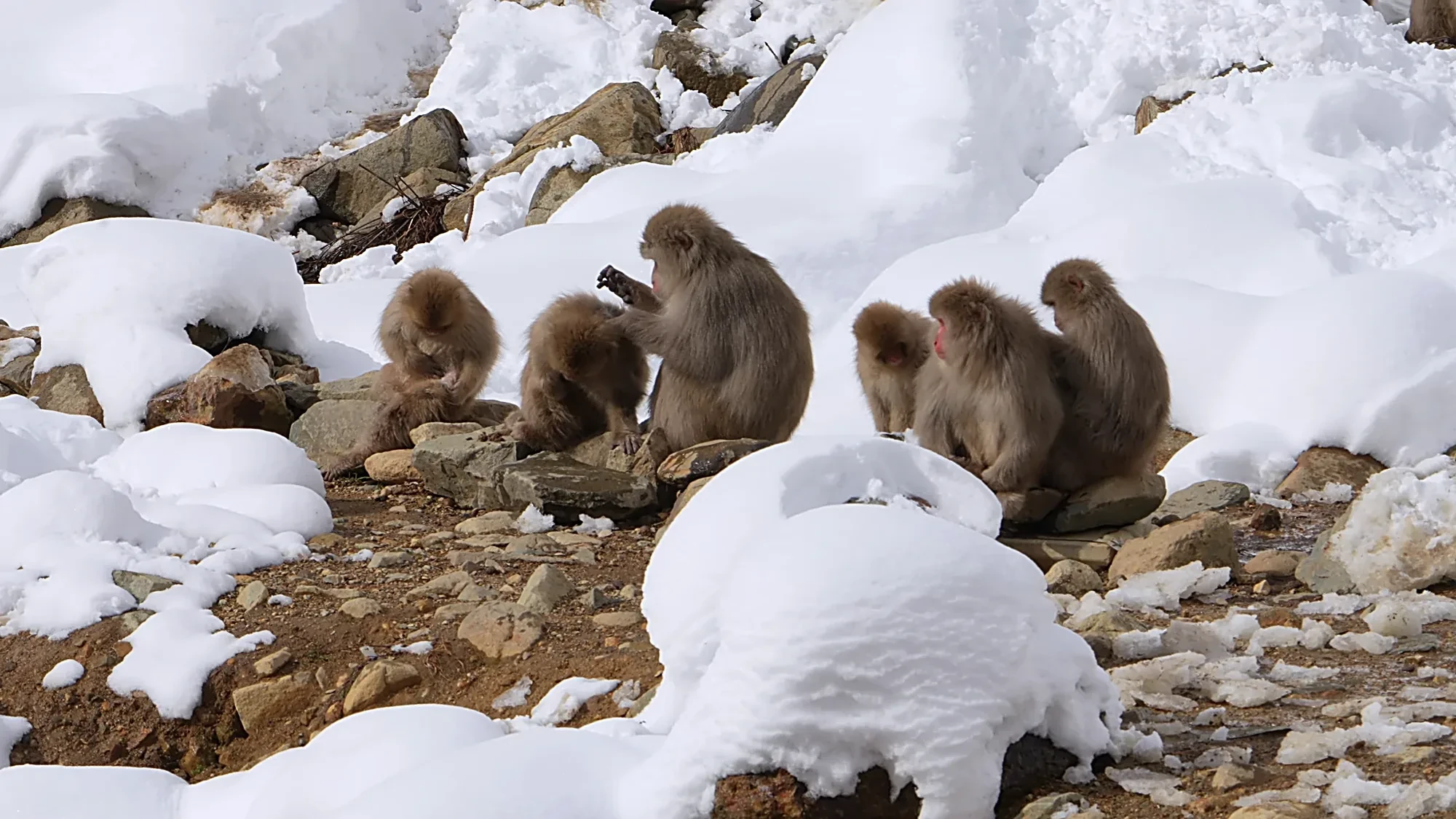
The viewing area is compact — a relatively small clearing centered on the hot spring pool. Most visitors see monkeys within moments of arriving. In winter, many will be sitting in or near the steaming water, while others groom each other on the surrounding rocks, play in the snow, or forage nearby. The troop numbers around 160, and though they are rarely all present at once, it is common to encounter several dozen during a single visit.
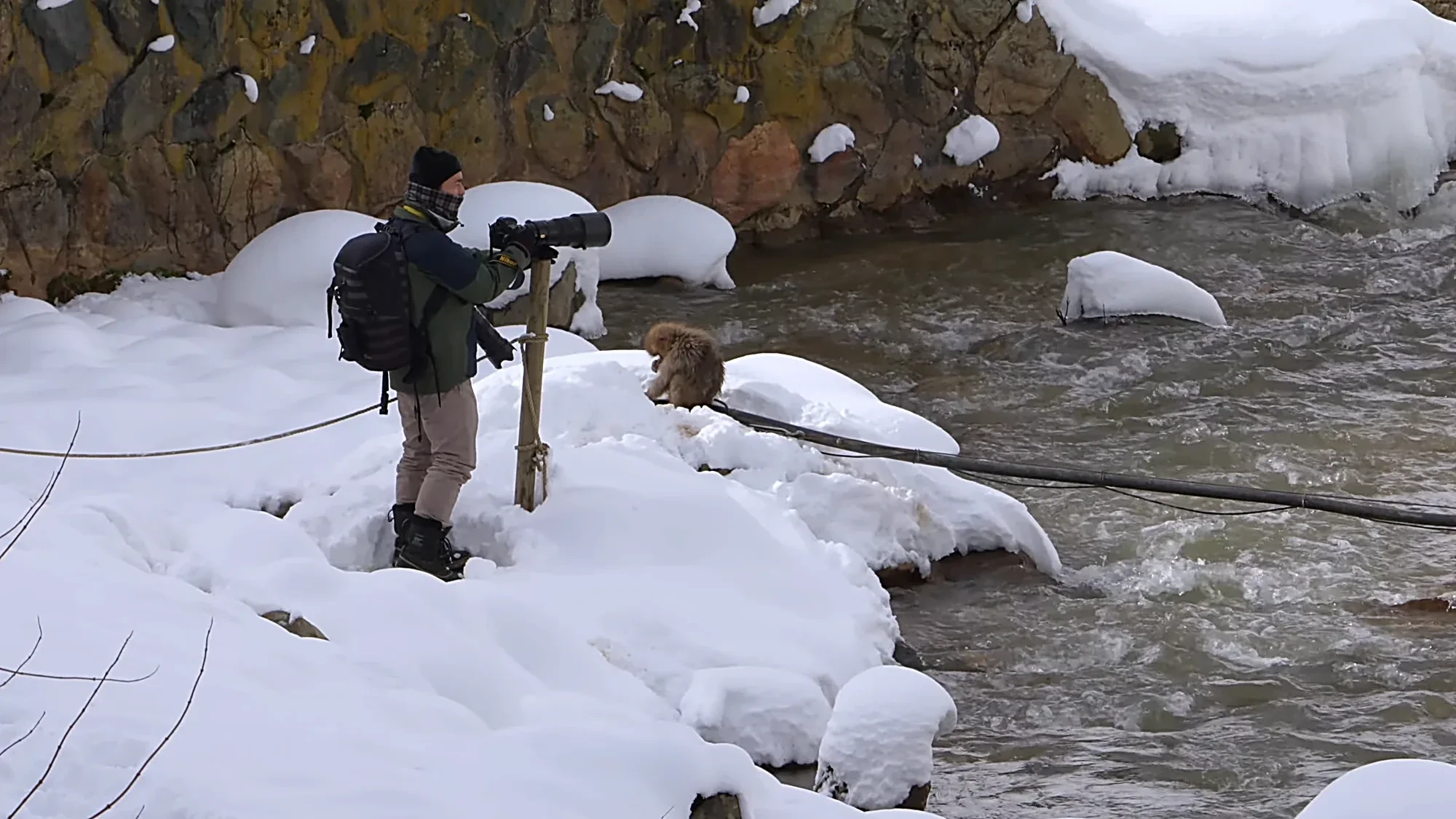
You really do stand this close — visitors line the pool's edge while the monkeys carry on, unbothered.
The macaques are thoroughly accustomed to people and largely ignore them. They are not tame, however. Visitors can often stand within a few meters of the animals, but that closeness depends on everyone behaving calmly and respectfully. Spend a few minutes watching and the social complexity becomes absorbing — dominance displays, grooming chains, mothers nursing infants, juveniles roughhousing. The hot spring is the headline attraction, but the troop’s social life is just as compelling.
Photography
Few wildlife locations offer this combination of proximity, dramatic backdrop, and cooperative subjects. Steam, snow, and expressive primate faces make for striking compositions at almost any skill level. Some practical considerations:
A medium telephoto lens (70–200mm equivalent) lets you fill the frame without crowding the animals. Wide-angle lenses capture the full pool scene with the snowy landscape behind.
Lens fogging is a persistent nuisance. The temperature gap between cold air and warm steam causes rapid condensation. Keeping the camera tucked inside your jacket between shots helps, as does allowing gradual temperature adjustment.
Tripods are allowed but awkward to position in the often-crowded viewing area. A monopod or image-stabilized lens is more practical.
Overcast winter days produce soft, diffused light — actually ideal for wildlife portraits, as harsh shadows on faces disappear.
The best light tends to fall in the early morning, shortly after the park opens. This also coincides with thinner crowds and, in cold weather, the highest likelihood of monkeys in the pool.
Do not expect empty, unobstructed scenes during peak winter weekends. The viewing area is small and popular. Patience, positioning, and a willingness to wait for a clear moment are part of the craft here.
Visitor Etiquette
The park posts clear rules at the entrance, and staff enforce them. These exist to protect both the monkeys and the visitors:

The park's 'Requests for Visitors' board lays out the rules — don't touch, don't feed, no flash — and the map says it's about 120 m (400 ft) more to the hot spring.
Do not touch the monkeys. They are wild and may bite or scratch if they feel cornered.
Do not feed them. Only park staff provide food. Human snacks cause health issues and change natural behavior patterns.
Avoid prolonged, direct eye contact. Macaques can read this as a threat.
No flash photography. Flash startles the animals and disrupts the group.
Keep food and drinks hidden. The monkeys are smart and will investigate bags if they smell something interesting. Tuck water bottles away.
Give the monkeys the right of way. If one walks toward you, step aside calmly.
Watch children closely. Young kids should stay near adults at all times.
Peak crowding falls between mid-morning and early afternoon during winter. Arriving right at opening offers the best combination of thin crowds and good light.
Facilities at the Park
Jigokudani Monkey Park is a wilderness site, and facilities are minimal. Knowing what is and is not available helps you plan accordingly.
Restrooms are located at the trailhead parking area and again at the park entrance near the ticket counter. There are no restrooms along the 1.6-kilometer forest trail between the two, so use them before you set out.
There are no food vendors, cafes, or vending machines at the viewing area. A small gift shop operates near the park entrance where you can buy souvenirs and basic items, but it does not sell meals or substantial snacks. Bring water and anything you might want to eat during your visit, and keep it concealed in your bag to avoid attracting the monkeys’ attention.
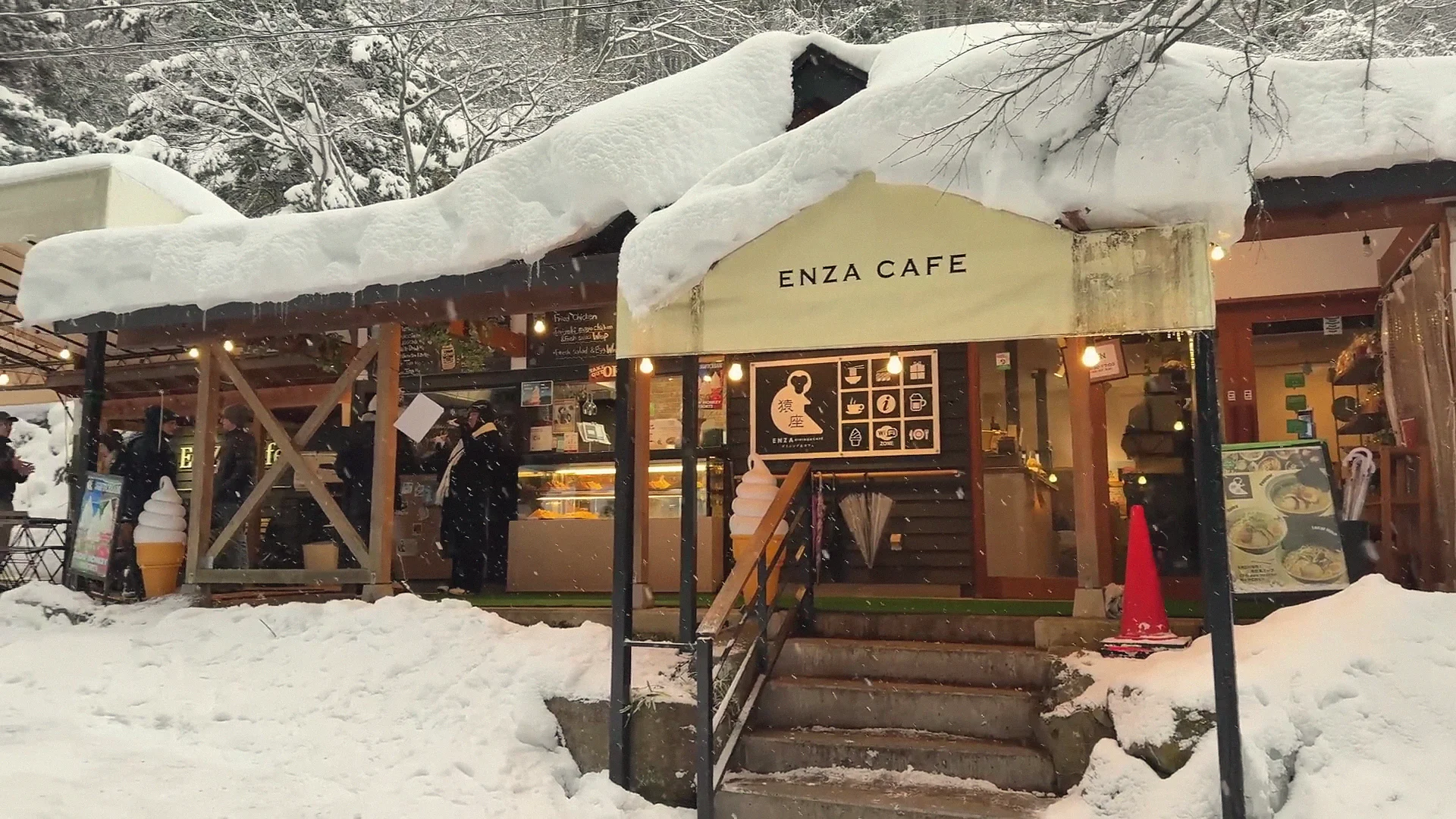
Enza Café at the trailhead — last coffee, soft-serve and restrooms before (or after) the 1.6 km walk to the monkeys.
There is no indoor shelter or covered area at the viewing site itself. In heavy snow or rain, you are exposed to the weather for the duration of your stay. Dress for the conditions and bring rain gear if the forecast is uncertain.
No lockers are available at the park. Travel light — a daypack with your essentials is easier to manage than a heavy bag, and you will be carrying it on the trail in both directions.
Ticket Prices and Opening Hours
Entry fees are modest. As of the most recently available information:
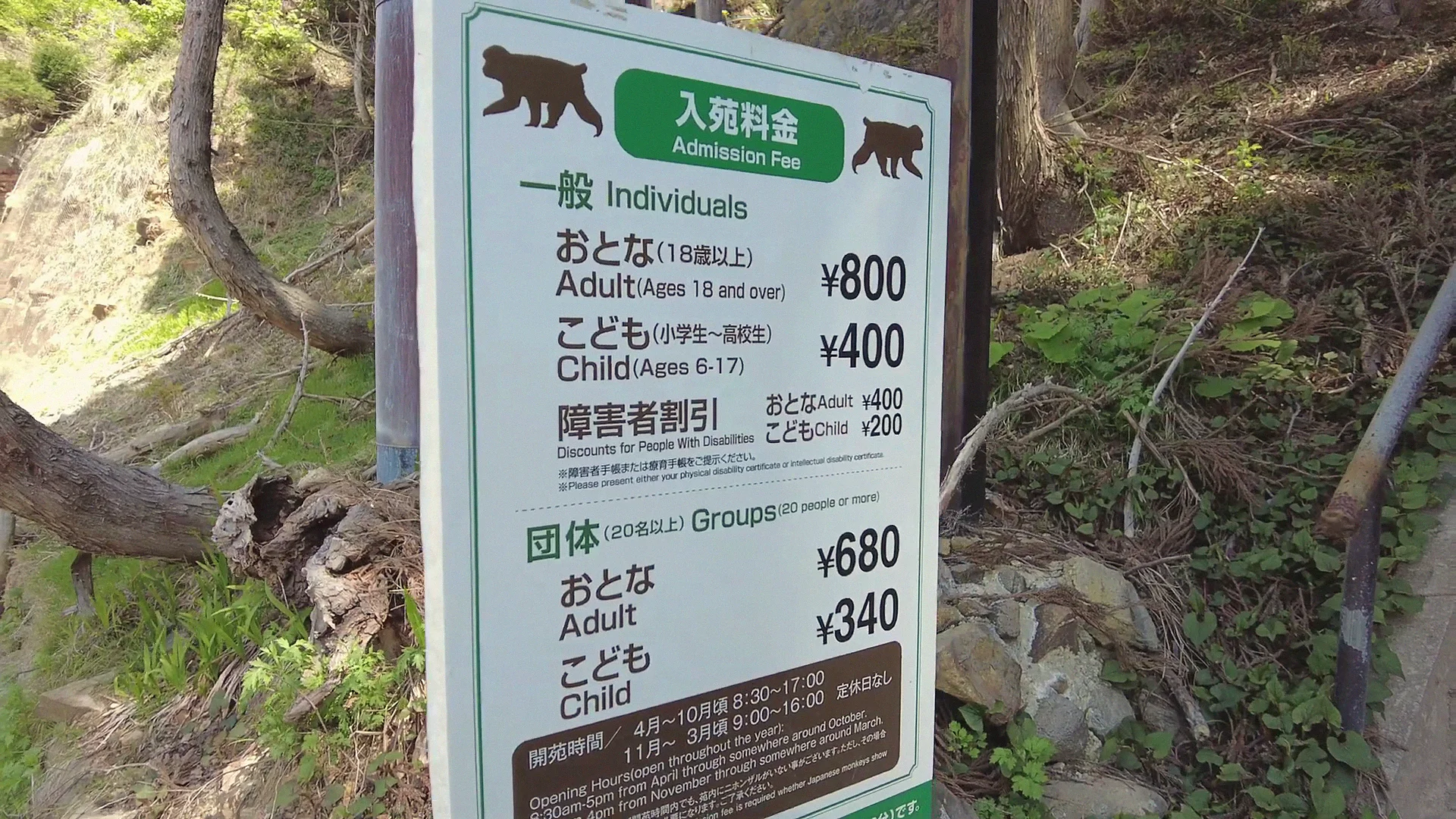
Admission is ¥800 (about US$5) for adults and ¥400 for children; the gate sign also lists group rates and the seasonal hours (8:30–17:00 Apr–Oct, 9:00–16:00 Nov–Mar).
Adults (18 and over): 800 yen (~$5)
Children (ages 6–17): 400 yen (~$3)
Children under 6: Free
Cash is accepted at the entrance. Electronic payment may be available, but don’t count on it — rural Nagano still runs largely on cash, and smaller facilities in the area often do not take cards.
Seasonal hours:
April–October: Approximately 8:30 AM to 5:00 PM
November–March: Approximately 9:00 AM to 4:00 PM
Hours are subject to change, and severe weather can force unexpected closures. Check the official Jigokudani Monkey Park website on the day of your visit. No advance reservations are accepted; entry is first-come, first-served.
There is no enforced time limit once inside. Most visitors spend 30 minutes to an hour at the viewing area, though photographers and wildlife enthusiasts often linger much longer.
Where to Stay Near the Snow Monkey Park
Spending the night near the park deepens the experience considerably. Two traditional hot spring villages offer accommodation within easy reach of the trailhead, both with a strong selection of ryokan (Japanese inns) and their own bathing culture. For detailed accommodation recommendations, see our full Where to Stay Near the Snow Monkey Park guide.
Shibu Onsen
Shibu Onsen has been welcoming bathers for more than 1,300 years. Its narrow, stone-paved streets wind between traditional wooden ryokan, many still run by the same families who built them.

Late light on Shibu's stone lane — wooden inns, paper lanterns and the gentle curve of a street that's welcomed bathers for over 1,300 years.
The village is best known for its nine public bathhouses — called “sotoyu” — each fed by a different mineral spring. Guests at participating ryokan receive a wooden key that unlocks all nine. Wandering from bath to bath in a yukata (light cotton robe) and wooden geta sandals, steam rising around you in the cold night air, is one of the most atmospheric experiences in rural Japan. For a complete overview, see our Shibu Onsen Guide.
The village sits slightly closer to the monkey park trailhead than Yudanaka, and its quieter, more traditional character appeals to visitors seeking a slower pace. Shibu Onsen is also frequently cited as an inspiration for the bathhouse town in Hayao Miyazaki’s animated film Spirited Away, though this connection remains informal and unconfirmed by the studio.
Yudanaka Onsen
Yudanaka sits at the end of the Nagano Dentetsu railway line, making it the more accessible option for those relying on public transport. The town is larger than Shibu and offers a broader range of accommodation — traditional ryokan alongside modern hotels and guesthouses.
Public baths, small restaurants, and souvenir shops line the quiet streets. Several ryokan here run shuttle services to the monkey park trailhead, a genuine convenience in winter.
Why Stay Overnight?
Beyond convenience, a ryokan stay adds a layer of cultural depth that a day trip cannot match. Most rates include a multi-course kaiseki dinner and a traditional breakfast — both worth the trip on their own. Bathing in your inn’s onsen, especially a rotenburo (outdoor bath) ringed by snow, parallels the monkey park experience in a way that feels unexpectedly resonant: you and the macaques, both seeking warmth in the same mountain valley.
Staying locally also means reaching the park early, before the crowds arrive and while the morning light is at its best.
Suggested Itineraries
These three itineraries outline the most common ways to structure a visit. Each can be adapted to your pace and interests. For more ideas on activities in the area, see our Things to Do Near the Snow Monkeys page.
Day Trip from Tokyo
Depart Tokyo Station on the Hokuriku Shinkansen by 8:00 AM. Arrive at Nagano Station by roughly 9:30 AM. Transfer to the Nagano Dentetsu line to Yudanaka, then take a bus or taxi to the trailhead. Walk to the park, spend an hour or more with the monkeys, and walk back. Return to Yudanaka for a late lunch, then retrace the route to Tokyo, arriving by early evening. This is a full day and leaves little slack, but it works for visitors with limited time.
Overnight from Nagano
Take the Nagano Dentetsu train to Yudanaka in the afternoon. Check into a ryokan in Shibu Onsen or Yudanaka Onsen. Spend the evening exploring the village and soaking in the public bathhouses or your inn’s private onsen. Enjoy a kaiseki dinner at the ryokan. The next morning, walk or shuttle to the monkey park shortly after opening, spend the morning with the troop, then return to the village for a bath and breakfast before heading back to Nagano.
Two-Day Snow Monkeys and Shibu Onsen
Day 1: Arrive in the Yamanouchi area by early afternoon. Check into a ryokan in Shibu Onsen. Walk to the monkey park for an afternoon visit — crowds thin out later in the day, and late afternoon light can be beautiful. Return to Shibu Onsen for dinner and the sotoyu bathhouse circuit.
Day 2: Revisit the monkey park first thing in the morning for the quietest conditions and the best chance of seeing the troop in the hot spring. Return to the village for a leisurely breakfast and a final soak. Depart for Nagano by midday, with time to visit Zenkō-ji temple or explore the city’s soba restaurants before continuing onward.
Combining with Other Nagano Attractions
The Yamanouchi area and Nagano city together offer enough to fill two or three days comfortably, and combining the monkey park with nearby attractions turns a focused wildlife trip into a broader exploration of one of Japan’s most rewarding mountain regions.
Zenkō-ji Temple in central Nagano is one of the most important Buddhist temples in Japan, founded in the seventh century and home to what is believed to be the first Buddhist statue ever brought to the country. The temple’s main hall, its atmospheric underground passage, and the surrounding pilgrimage streets are worth a half-day visit. Nagano Station is a short bus ride or 20-minute walk from the temple grounds, making it easy to visit on the way to or from the monkey park.
Nagano’s soba noodle culture deserves attention in its own right. The prefecture is one of Japan’s premier buckwheat-growing regions, and handmade soba served cold with dipping sauce or in hot broth is a local specialty. Restaurants near Nagano Station and around Zenkō-ji serve excellent soba at reasonable prices. A soba lunch before or after your monkey park excursion is an easy and rewarding addition.
Skiing and snow sports are another option for winter visitors. The Shiga Kogen ski area, one of the largest in Japan and a venue for the 1998 Winter Olympics, lies just a few kilometers from the Yamanouchi area. Nozawa Onsen, a charming ski village with its own historic hot spring culture, is also within reach. Combining a day of skiing with a monkey park morning and an onsen evening is a strong winter itinerary for active travelers.
Tips for Visiting the Snow Monkeys
For a full list of practical advice including packing, transport, and seasonal considerations, see our Travel Tips page.
Get there early. The first hour after opening tends to be the quietest, the light the most photogenic, and the monkeys the most active in the pool — cold mornings drive them into the water.
Aim for a weekday. Weekend and holiday crowds can be heavy, especially around Japanese New Year and through February.
Carry cash. The park entrance, local buses, and many small businesses nearby are cash-only.
Check conditions before you go. Heavy snowstorms occasionally close the trail. The park’s website and social media channels post real-time updates on conditions and monkey activity.
Budget enough time. Between the walk in, time at the viewing area, and the walk out, allow at least two to three hours for the full visit.
Be patient at the pool. The monkeys come and go on their own terms. If the pool is empty when you arrive, wait. Activity often picks up once staff scatter food in the area.
Leave no trace. Carry out everything you carry in. No litter on the trail or at the park.
Conservation and Responsible Visiting
Jigokudani Monkey Park exists because of a careful balance between wildlife conservation, scientific observation, and public access. The park has operated since 1964 as a site where researchers and visitors alike can observe Japanese macaques in a natural setting, and the revenue from entrance fees contributes directly to the ongoing maintenance of the park, the trail, and the management of the troop’s habitat.
The monkeys’ hot spring bathing behavior has drawn global attention to the species and to the broader ecology of the Joshinetsu Kogen highlands. That visibility carries responsibility. The troop’s comfort around humans is the result of decades of careful, non-intrusive management — and it can be undermined by visitors who ignore the rules. Feeding the monkeys, touching them, chasing them for photographs, or behaving loudly near the pool all have the potential to alter the troop’s behavior in ways that are difficult to reverse. The rules posted at the entrance are not suggestions. They are the terms of access to a wild animal’s home.
Visitors who approach the park with respect — for the animals, for the staff who manage the site, and for the natural environment — contribute to the long-term survival of one of the most remarkable wildlife encounters anywhere in the world. Those who treat it as a photo opportunity and nothing more take more than they leave. The difference is worth being conscious of.
Is the Snow Monkey Park Worth Visiting?
What makes Jigokudani exceptional is the rarity of the encounter. A learned cultural behavior in wild primates, observed at close range, in a volcanic mountain landscape blanketed in snow — very few wildlife experiences anywhere in the world offer this combination. The setting feels natural rather than curated, and the proximity between visitor and animal is remarkable without feeling forced.
The experience gains another dimension when paired with a stay in the surrounding onsen towns. The Yamanouchi area represents a side of Japan that most international travelers never see — rural, mountainous, steeped in tradition, and far removed from the pace of Tokyo or Osaka. Soaking in an outdoor hot spring at your ryokan, after a morning watching monkeys do exactly the same thing a few kilometers away, creates a quiet sense of kinship with the landscape that is hard to find elsewhere.
This is a conservation site, not a theme park. The monkeys are wild, the weather can be harsh, and reaching the viewing area requires a walk through the forest. None of that is a drawback. The cold air, the sound of the river, the effort of the trail, and the patience needed to wait for the troop all contribute to an experience that feels earned. For wildlife enthusiasts, photographers, families with children sturdy enough for the walk, and anyone drawn to Japanese nature and culture, Jigokudani is one of the most distinctive destinations in the country.
Summary
Jigokudani Monkey Park is home to a wild troop of Japanese macaques that have learned to bathe in natural hot springs — a behavior found nowhere else on earth. Located in the mountains of Nagano Prefecture, the park is reachable from Tokyo in roughly three hours by bullet train and local transport.
Winter remains the peak season for the classic snow-and-steam scene, though the park stays open year-round. Dress warmly, wear solid footwear, arrive early, and consider spending a night in nearby Shibu Onsen or Yudanaka Onsen to make the most of the region’s ryokan and hot spring culture.
Respect the monkeys as the wild animals they are, follow the posted rules, and leave the park as you found it. Jigokudani rewards those who approach it with patience, curiosity, and genuine respect for the natural world.
Practical information such as ticket prices, opening hours, and transportation schedules is subject to change. Confirm current details on the official Jigokudani Monkey Park website before your visit.
Tips
Wear proper shoes for the snowy trail
Arrive early to avoid crowds
Bring a camera with zoom
Frequently asked questions
Are the snow monkeys wild?
Do the monkeys bathe in the hot spring year-round?
Can I visit the snow monkeys as a day trip from Tokyo?
How difficult is the walk to the park?
Can I touch or feed the monkeys?
Is the park suitable for children or older visitors?

Show all sources
1. 山ノ内町役場 (Yamanouchi Town official onsen list) — Municipal record: park access, walking times, climate and setting.
2. Go! NAGANO (Nagano Prefecture Tourism) — Prefectural official guide: access legs, hours, area detail.
3. 地獄谷野猿公苑【公式】 (Jigokudani Monkey Park, official) — The park's official account: opened 1964, elevation, bathing behavior, admission, conduct.
4. 長野電鉄 (Nagano Electric Railway) — Railway official: Snow Monkey Pass, fares, ticketing.
Verified July 7–16, 2026
Related guides
The Park and Monkeys
Best Time to See Snow Monkeys
January and February for snow and steam. June for newborns. The monkeys are there every day of the year.

The Park and Monkeys
How Long Do You Need at Snow Monkey Park
Most visitors spend 30 to 60 minutes at the viewing area. The full trip from Nagano runs three to four hours.

The Park and Monkeys
1-Day Snow Monkey Itinerary
It works, but only with discipline. The 8:00 AM shinkansen, two hours with the monkeys, home by dinner.